


Following my earlier blog on Cybersecurity Mesh Architecture (CSMA), I kept thinking about how these principles translate into practice. Organisations are increasingly embracing hybrid networks and multi-cloud environments, which only increases the need for an integrated security approach. And that brings us to the topic that also took centre stage at the recent Check Point CPX: Hybrid Mesh Network Security.
Follow the white rabbit
This expression was originally used in Alice in Wonderland, but what is particularly interesting is how people later came to interpret and apply it to support their own ideas and beliefs. For example, it was also used in The Matrix.
Whether you look at it literally or symbolically, following the white rabbit means following an unexpected clue or a seemingly insignificant, incredible (and perhaps even somewhat absurd) sign. This path can lead you to extraordinary and wondrous experiences that challenge your beliefs, expand your horizons, change your view of reality and possibly even transform your life.
From security map to spider web
Have you noticed how today’s security landscape increasingly feels like a complex spider web rather than an uncluttered map? Hybrid environments, multi-cloud deployments and IoT extensions make managing security more challenging than ever. It’s like trying to secure a city where new roads are being built every night. And that is why Hybrid Mesh Network Security Architecture comes around the corner.
The concept is not new, but is rapidly gaining popularity as organisations struggle to maintain visibility and control. Think not of one castle to secure, but an entire kingdom with outposts spread across distant areas. This reflects the reality of hybrid workforce, hybrid application landscap and hybrid infrastructure. Traditional perimeter security remains relevant, but has long since ceased to be sufficient.
What does a Hybrid Mesh Architecture offer?
A Hybrid Mesh Security Architecture provides a unified framework in which different security solutions are integrated and coordinated.
It is all about consistent policy enforcement, real-time threat detection and adaptive response capabilities. Think of it as a well-coordinated defence team communicating seamlessly, whether they are guarding the main gate or patrolling remote watchtowers.
What also stands out here is how this architecture fits seamlessly with the widely deployed shift towards Zero Trust principles. Identity becomes the new perimeter and context determines security decisions. But here is the challenge: implementation. It sounds great on paper, but merging legacy systems, cloud-native applications and emerging technologies is anything but easy.
The risk? Gaps in coverage, inconsistent policies and a plethora of alerts no one cares about anymore. That’s where automation and AI-driven analytics come in. By correlating data from multiple sources, we can prioritise threats more effectively and respond faster. But, as always, technology is only part of the solution. Governance, process alignment and continuous monitoring are the silent forces behind the success of these types of architectures.
The role of Check Point
What is interesting is how Check Point is positioning itself in this playing field. They have fully embraced the Hybrid Mesh Network Security Architecture with their solutions. Their Infinity architecture is a prime example of this: a platform that enables seamless integration between networks, cloud environments and endpoints. This provides a holistic view, allowing organisations to respond quickly and effectively to threats wherever they occur.
Check Point has fully embraced this shift with their Hybrid Mesh Network Security Architecture. Their “Infinity architecture “is an excellent example of how networks, cloud environments and endpoints can be seamlessly integrated into one holistic platform.
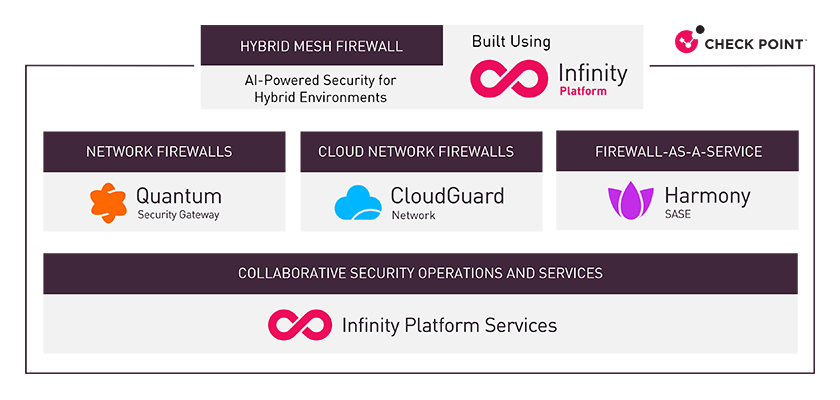
Using AI and advanced automation, Check Point proactively identifies threats and neutralises them before they can do any damage. Their approach highlights not only technical innovation, but also the need for a central management layer that brings simplicity and overview to a complex environment.
Moreover, it raises the question of how to keep this approach scalable and manageable. Because while the promise of a unified security layer is tempting, the danger is that we are actually adding another layer of complexity. Regular reviews, involvement of all stakeholders and a clear vision of risk management are crucial to maintain the balance.
Conclusion: Hype or necessary evolution?
Are we following the right “white rabbit” here? I believe Hybrid Mesh Network Security Architecture is not just hype, but a necessary evolution in our dynamic security landscape. The only question is: how do we ensure that it delivers on its promise without degenerating into yet another complex layer in an already complicated whole?